
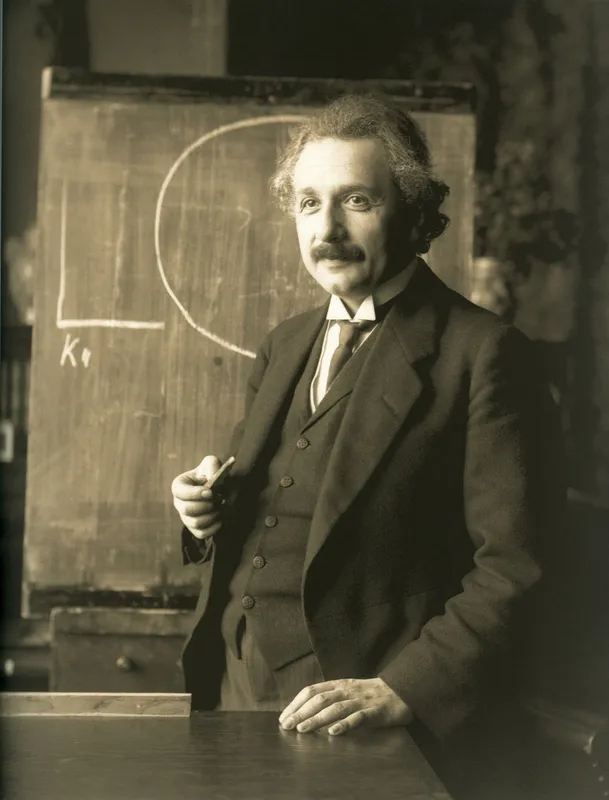
Albert Einstein — Birth Chart
The physicist who reshaped our understanding of reality.
ⓘ Birth time unknown — chart cast for noon, so the Ascendant and houses are not determined. source
Albert Einstein was a German-born theoretical physicist widely held to be one of the greatest scientists of all time. His theory of relativity and the equation E=mc² transformed our understanding of space, time, energy and gravity, reshaping modern physics forever.
Awarded the 1921 Nobel Prize in Physics for the photoelectric effect, he became a global symbol of genius and, later, a passionate advocate for peace and civil rights. He died in 1955, named Time's Person of the Century.
Wikipedia — for the full story.
A note on accuracy: no verified birth time exists, so AstroNoir casts a noon chart — the signs hold, but the Ascendant and houses can't be determined.
A Pisces Sun explains the boundless, intuitive imagination and the capacity for the dreamlike "thought experiments" that unlocked relativity — a mind that saw the universe as a fluid whole; a Sagittarius Moon adds the restless, philosophical hunger for the biggest questions. Mercury in Aries gives the pioneering, rule-breaking intellect, while Jupiter in Aquarius lends the visionary, humanitarian, unconventional spirit. The AiChat below reads from this same chart.
☉Sun
♓Pisces
☽Moon
♐Sagittarius
↑Rising
♋Cancer
☿Mercury
♈Aries
♀Venus
♈Aries
♂Mars
♑Capricorn
This is Albert Einstein's real natal chart. Ask anything — love, money, talent, shadow — and AstroNoir reads it live, just for you.
Beyond the personal planets, these are the deeper, slower forces — the generational and karmic signatures shaping Albert's story. Tap any one.
♃Jupiter
♒Aquarius
House 9
♄Saturn
♈Aries
House 10
♅Uranus
♍Virgo
House 3
♆Neptune
♉Taurus
House 11
♇Pluto
♉Taurus
House 11
☊North Node
♒Aquarius
House 8
⚷Chiron
♉Taurus
House 11
⚸Lilith
♈Aries
House 11
Curious what YOUR chart says?
Get your own natal chart calculated to the minute — plus daily readings and AstroNoir AI. Free to start.
Create your free chart →Is he loyal in love?
Albert Einstein's approach to love is deeply intertwined with his public identity and his intellectual drive, as evidenced by the heavy concentration of planets in his 10th house. With his Venus in Aries conjunct Pallas and Juno, he experiences affection as an active, almost strategic pursuit; he is drawn to partners who stimulate his mind and can keep pace with his rapid-fire thoughts. This placement suggests that for him, loyalty is not a passive state of being, but an active commitment to a shared intellectual or social mission. He does not simply "fall" in love; he chooses a partner who fits into the grand architecture of his life's work.
However, the nature of his loyalty is complicated by his Moon in Sagittarius in the 6th house, which squares his Sun in Pisces. This aspect creates a fundamental tension between his need for deep, soulful connection and a restless, philosophical need for freedom and routine. While his Pisces Sun seeks a transcendent, almost spiritual union, his Sagittarius Moon craves expansion and variety, sometimes making him feel emotionally unmoored even when he is technically committed. He may find that his loyalty is strongest when his partner allows him the space to explore his own vast, internal landscapes without feeling tethered.
The presence of Mars in Capricorn in his 7th house of partnerships provides a stabilizing, albeit stern, influence on his long-term commitments. Mars here seeks structure, reliability, and a partner who possesses their own formidable sense of duty. Because Mars is in a trine aspect to his Pluto and Haumea, his connections are characterized by an intense, transformative power that demands total integrity. He is unlikely to tolerate superficiality, and his loyalty is often expressed through a disciplined, unwavering support of his partner’s ambitions and social standing.
Ultimately, his loyalty is less about emotional sentimentality and more about a profound respect for the "truth" of a relationship. With Mercury and Saturn conjunct in Aries, he values clarity and the ability to face difficult realities directly, rather than hiding behind romantic illusions. He is loyal to the ideas and the structures that he has built with another person, provided those structures do not stifle his innate need for intellectual autonomy. He seeks a partnership that functions like a well-ordered system, where truth and purpose remain the primary pillars.
What wounds shaped him?
Albert Einstein's wounds are deeply intertwined with his sense of identity and his public standing, as his Sun in Pisces resides in the 10th house. Because his Sun is in the house of reputation and authority, any perceived failure or misunderstanding of his character feels like a fundamental wound to his soul. This is intensified by a Sun square Moon aspect, which suggests a core tension between his public persona and his private emotional needs. He may often feel that the world sees a version of him that does not fully align with the intuitive, sensitive person living within his Sagittarius Moon in the 6th house.
The sting of intellectual or structural inadequacy is also present through his heavy Aries placements in the 10th house. With Mercury, Venus, and Saturn all conjunct in Aries, he carries a wound related to how his ideas are received and structured. The tight conjunction between Mercury and Saturn suggests a person who may have felt his early thoughts were too radical, too slow, or too "wrong" for the established order. This creates a drive to master logic and discipline to protect himself from the pain of being dismissed or misunderstood by authority figures.
Albert Einstein's relationship wounds are specifically highlighted by his Mars in Capricorn in the 7th house, which squares his Lilith in Aries. This placement suggests that his interactions with others are often shaped by a need for control or a fear of being dominated. He may experience a recurring theme where his drive for autonomy clashes with the heavy demands of partnership, leading to a sense of isolation within his closest bonds. The square to Lilith adds a layer of feeling "othered" or rebellious in his one-on-one connections, as if his very way of asserting himself is inherently disruptive to the stability others seek.
Finally, there is a profound wound related to his sense of belonging and his spiritual foundations, seen in his Neptune and Pluto conjunction in Taurus in the 11th house. With Neptune conjunct Chiron in the 11th, there is a specific ache regarding his place within groups, collectives, or the broader human community. He may feel a "holy wound" where he senses a deep connection to humanity, yet feels fundamentally alienated from the actual social structures that exist. This tension between his desire for universal truth and the gritty reality of human institutions is a central, shaping force in his life.
What drives him most?
Albert Einstein's primary drive is a profound, visionary synthesis of intuition and intellectual structure, centered heavily in his 10th house of public reputation and vocation. With his Sun in Pisces in the 10th house, he is driven by a need to manifest the invisible into the visible, seeking to give form to cosmic or abstract truths. This Piscean sensitivity is not passive; it is anchored by a powerful conjunction between Mercury and Saturn in Aries. This placement suggests that his mind does not merely wander through the ether, but actively seeks to conquer complexity through rigorous, disciplined, and pioneering thought.
The tension between his Pisces Sun and his Sagittarius Moon creates an internal engine fueled by a constant quest for meaning. His Moon in the 6th house suggests that his emotional well-being is deeply tied to the precision of his daily work and the mastery of his mental processes. Because his Moon squares his Sun, there is a persistent friction between his need for spiritual expansion and his need for practical, systemic order. He is driven to resolve this discord by creating new frameworks that can hold both the infinite and the measurable.
His drive is further amplified by a heavy concentration of planets in his 10th and 11th houses, pointing toward a life dedicated to large-scale impact. With Venus, Mercury, and Saturn all occupying the 10th house in Aries, he possesses a relentless, pioneering energy when it comes to his professional identity. He does not just want to understand the world; he wants to redefine its fundamental laws. This is supported by his Jupiter in Aquarius in the 9th house, which pushes him to seek truth through unconventional, systemic, and highly intellectualized philosophies.
Finally, his Mars in Capricorn in the 7th house provides the necessary grit to turn these high-minded ideals into tangible reality. While his Sun and Jupiter seek the heavens, his Mars provides a grounded, strategic approach to how he interacts with the world and its structures. He is driven by the desire to master the mechanics of reality itself, using his intellect as a tool for profound structural change. He seeks to bridge the gap between what is known and what is felt.
What is his spiritual side?
Albert Einstein's spiritual landscape is defined by a profound tension between the boundless, intuitive depths of his Piscean Sun and the restless, expansive energy of his Sagittarius Moon. With his Sun in Pisces occupying the 10th house, his sense of purpose and public identity is inextricably linked to the transcendental and the unseen. He does not merely seek knowledge; he seeks to dissolve the boundaries between the physical world and the cosmic infinite. This placement suggests that his highest calling involves translating divine or abstract concepts into a structure that the material world can grasp.
The placement of his Moon in Sagittarius in the 6th house adds a layer of philosophical seeking to his daily existence and his relationship with the body. He likely finds spiritual nourishment through the pursuit of truth, whether that manifests as a rigorous intellectual inquiry or a wandering, nomadic spirit. Because the Moon rules his 1st house of self, his emotional well-being is deeply tied to this sense of freedom and the ability to find meaning in the minutiae of his daily routines. There is a drive to turn even the most mundane tasks into a form of spiritual or philosophical practice.
His capacity for deep, transformative insight is further amplified by the heavy concentration of planets in his 10th and 11th houses, particularly the involvement of Uranus and Neptune. With Uranus in Virgo in the 3rd house, his mind functions like a lightning rod, catching sudden flashes of insight that feel more like revelations than logical deductions. This is complemented by Neptune in Taurus in the 11th house, which suggests that his spiritual ideals are often channeled through his connections to humanity and his vision for a collective future. He possesses a rare ability to ground high-concept cosmic truths into tangible, communal visions.
Finally, his spiritual path is not one of quiet retreat, but of intense, intellectual confrontation. His Mercury and Saturn conjunction in Aries in the 10th house indicates that he approaches the mysteries of the universe with a disciplined, almost combative precision. He does not accept spiritual dogma blindly; instead, he uses his intellect to strip away illusions until only the core truth remains. This marriage of Piscean intuition and Aries-driven mental rigor creates a spirituality that is as much about discovery and revolution as it is about peace.
Is he a leader or a rebel?
Albert Einstein's chart suggests he is neither a traditional leader nor a standard rebel, but rather a visionary disruptor who redefines the structures he inhabits. With his Sun in Pisces in the 10th house, his public identity is deeply intuitive and seeks to dissolve boundaries, yet his 10th house is heavily populated by fiery Aries placements. This creates a fascinating tension between his Piscean need for universal connection and an Aries drive to strike out with singular, pioneering intellect. He does not lead through command, but through the sheer force of a radical new perspective that demands to be seen.
The presence of Mercury, Venus, and Saturn all in Aries within his 10th house indicates that his mind and his authority are inextricably linked to the concept of the "first mover." He possesses a Mercury-Saturn conjunction in Aries, which grants him a disciplined, almost surgical ability to conceptualize complex truths and present them with unyielding authority. This isn't the rebellion of a teenager breaking rules for the sake of it; it is the rebellion of a genius who recognizes that the existing rules are mathematically or logically incorrect. He dismantles old paradigms not to cause chaos, but to build a more accurate reality in their place.
His Moon in Sagittarius in the 6th house further fuels this need for expansion and truth-seeking through his daily work and intellectual habits. The Moon's trine to his Venus and Pallas suggests that his creative problem-solving is deeply instinctive and harmonizes well with his pursuit of higher knowledge. While his Mars in Capricorn in the 7th house provides a grounded, strategic approach to his interactions with others, it also squares his Lilith and Juno. This suggests that his drive for autonomy and his unconventional methods may often create friction in his closest partnerships or social contracts.
Ultimately, his chart points to someone whose "leadership" is actually a form of intellectual revolution. With Jupiter in Aquarius in the 9th house opposing Uranus in Virgo, his expansion comes through the sudden, disruptive realization of how the micro (Virgo) relates to the macro (Aquarius). He is a pioneer of the unseen, using the structure of the 10th house to broadcast insights that feel both ancient and futuristic. He does not follow the path; he rewrites the map so that others can finally see where they are going.
How does he cope with loss?
Albert Einstein's approach to loss is deeply intertwined with his Pisces Sun in the 10th house, which suggests that when he faces endings, he processes them through a lens of profound, almost cosmic empathy. Because his Sun is in a sign ruled by Neptune, loss is not merely a practical setback for him; it is a dissolution of a perceived reality. He tends to absorb the emotional weight of what has been lost, feeling it as a shift in the very fabric of his public identity or his sense of purpose. This can make his grief feel vast and uncontainable, as if the boundaries between himself and the void are blurring.
The way Albert Einstein navigates this emotional dissolution is complicated by his Moon in Sagittarius in the 6th house. While his Sun wants to merge with the sorrow, his Moon seeks to find meaning or a philosophical framework to justify the pain. He may attempt to cope by intellectualizing the loss or by seeking a "greater truth" that explains why things must end. However, with the Moon in the 6th house, this emotional processing often manifests in his physical routines or his daily work habits. He might find himself obsessively focusing on small, technical details or repetitive tasks as a way to anchor himself when his internal world feels too fluid.
There is a significant tension between Albert Einstein's need for philosophical expansion and his need for structural stability. His Mercury and Saturn are conjunct in Aries in the 10th house, which provides a sharp, disciplined mental edge that can act as a shield against total emotional collapse. When loss hits, he has the capacity to pivot toward intense, focused mental activity, using logic and rigorous thought to reconstruct a new reality. This conjunction suggests that he copes by building new intellectual structures, turning the chaos of grief into a problem that can be solved through concentrated effort and disciplined study.
Furthermore, his Mars in Capricorn in the 7th house provides a grounded, pragmatic drive when dealing with the loss of connections or partnerships. Instead of remaining purely in the ethereal realm of his Pisces Sun, his Mars allows him to take decisive, controlled action to manage the practical consequences of an ending. He does not simply mourn; he organizes, he strategizes, and he exerts his will to maintain order in the face of upheaval. This blend of cosmic sensitivity and iron-willed discipline allows him to endure significant transitions by simultaneously feeling the depth of the void and building a ladder out of it.
What is Albert Einstein's attraction style?
Albert Einstein's attraction style is a complex interplay between a deep, soulful need for spiritual connection and a highly intellectual, almost combative approach to romantic engagement. With his Sun in Pisces in the 10th house, he projects an aura of profound, universal empathy that draws people toward his public persona. However, his romantic magnetism is heavily driven by his Venus and Mercury in Aries in the 10th house. This creates a signature of "intellectual pursuit," where Albert Einstein is most attracted to minds that can challenge him, spark a debate, or move at a rapid-fire pace.
The presence of Venus in Aries suggests that Albert Einstein does not enjoy the slow, traditional courtship; he prefers the thrill of the chase and an immediate, fiery spark. He is likely drawn to partners who possess a certain level of independence and strength, as his Venus is closely conjunct Pallas and Makemake, suggesting that his attraction is inextricably linked to a partner's strategic intelligence and their ability to stand as an individual. He finds beauty in competence and the ability to navigate the world with decisive action. This is not a passive romanticism, but one that requires active mental stimulation to remain engaged.
His Moon in Sagittarius in the 6th house adds a layer of restlessness to his emotional needs, suggesting that he seeks a partner who feels like an adventure or a fellow traveler. Because his Moon is in a sign ruled by Jupiter, and his Jupiter is in Aquarius in the 9th house, Albert Einstein is attracted to those who expand his worldview or challenge his philosophical foundations. There is a tension here: while his Pisces Sun seeks a merging of souls, his Aries placements and Sagittarius Moon demand autonomy and intellectual freedom. He may find himself oscillating between wanting a deep, cosmic union and needing a partner who respects his intense need for mental space.
The dynamics of Albert Einstein's one-on-one relationships are further defined by Mars in Capricorn in the 7th house. This placement indicates that in a partnership, he gravitates toward stability, structure, and perhaps even a touch of formality or authority. While his Venus seeks the heat of Aries, his Mars demands that the partner be someone who is capable of building something lasting and tangible. He is attracted to those who can ground his expansive, sometimes nebulous Piscean visions into reality through discipline and hard work. This creates a fascinating paradox where he is seduced by the spark of the intellect but anchored by the strength of the character.
Birth data curated from public records. Chart positions computed with Swiss Ephemeris. AstroNoir readings are AI-generated for entertainment.